Why Perfume Should Be Applied to Skin, Not Clothes, for Best Results
You get a longer-lasting, more dynamic scent when you apply perfume to your skin, not clothes. Your body’s natural warmth-especially at pulse points like your wrists and neck-gently releases top, heart, and base notes over 6–8 hours. Skin’s oils and pH transform 15–20% fragrance oil in Eau de Parfum into a personalized aroma, while fabric traps scent statically. Avoid staining delicate silks or altering projection. There’s more to mastering your signature scent.
We are supported by our audience. When you purchase through links on our site, we may earn an affiliate commission, at no extra cost for you. Learn more. Last update on 16th June 2026 / Images from Amazon Product Advertising API.
Notable Insights
- Skin’s natural oils and body heat help fragrance evolve through top, heart, and base notes for a dynamic scent experience.
- Pulse points on the skin release fragrance gradually due to warmth and blood flow, enhancing projection and longevity.
- Applying perfume to skin creates a personalized aroma by interacting with individual body chemistry and pH levels.
- Fabric traps scent statically, preventing the natural development and layering of fragrance notes over time.
- Alcohol in perfume can damage delicate fabrics like silk and polyester, while skin safely diffuses the fragrance without residue.
Why Perfume Smells Better on Skin
Skin, not fabric, is your fragrance’s true canvas. When you apply perfume directly to your skin, the heat from your skin reacts with your body chemistry, helping the scent unfold naturally. The natural oils in your skin enhance diffusion, especially at warm pulse points like wrists and neck, where circulation is strong. Top, heart, and base notes evolve smoothly over time, giving better sillage and projection. Unlike fabric, which traps and distorts fragrance, your skin transforms it into a personalized scent-unique to you. High-quality perfumes like My Life for Him or My Dream for Her are crafted to bloom on skin, not cloth. With eau de parfum concentrations lasting up to 8 hours, and real testers noting stronger performance on skin, the choice is clear: apply to your skin and let your chemistry make it yours.
How Body Heat Changes Your Fragrance All Day
You already know your skin transforms perfume into something uniquely yours, but what really makes that scent shift throughout the day is the steady warmth of your body. Body heat gently activates your fragrance in stages, starting with top notes, then heart notes, and finally base notes, creating a natural scent evolution over 6–8 hours. Skin warmth helps slow alcohol evaporation-Eau de Parfum is 70–90% alcohol-allowing a more controlled release. At pulse points, where skin runs 91–99°F, heat-driven evaporation lifts aromatic molecules, boosting diffusion. Skin application lets your natural oils and pH interact with the perfume, making it smell subtly different on you. This process enhances fragrance longevity, ensuring a lingering fragrance that adapts all day.
Pulse Points: Where to Spray for Maximum Scent
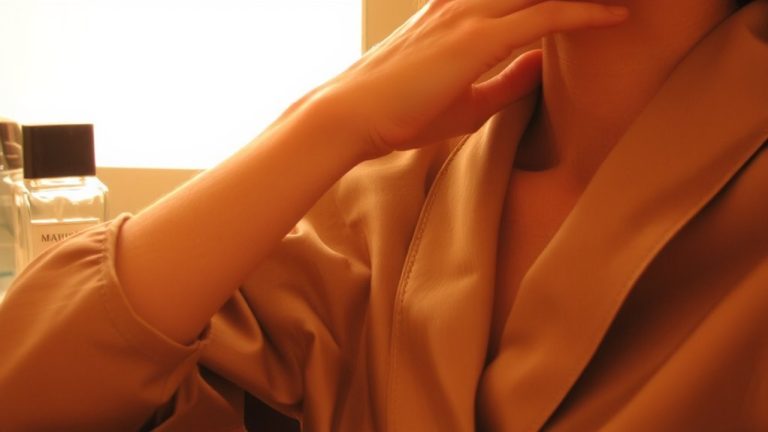
When applied to the right spots, your perfume doesn’t just last longer-it performs better, unfolding its top, heart, and base notes smoothly over 6–8 hours. Apply perfume directly to pulse points like your inner wrists, base of the throat, and behind the ears, where blood vessels sit close to the skin. These spots run 91–95°F, creating warmth that helps your fragrance evolve and project. Spray perfume 5–8 inches away for even, waste-free coverage. Applying perfume directly to these areas-not clothes-ensures the scent reacts with your skin chemistry. With eau de parfum (15–20% fragrance oil), just two to three spritzes leave a lasting impression. You’ll notice it lingers throughout the day, maintaining depth and presence. Remember, it’s perfume on skin, not fabric, that truly delivers in the skin vs clothes debate.
Why Perfume Smells Different on Skin vs Clothes
Because your skin’s natural warmth and chemistry actively reshape a fragrance over time, perfume ends up smelling different-and more dynamic-on you than it does on fabric. Skin vs clothes makes a real difference: your body heat and pH level interact with natural ingredients, helping the scent evolve through top, heart, and base notes. Perfume on your skin develops a scent that’s uniquely yours, deepening at pulse points for a more complex aura. Skin helps your fragrance last longer and feel alive, turning it into a true signature scent. On the other hand, perfume on clothes sits static-especially on cotton and wool-preserving the original blend but missing that personal touch. Even if you have sensitive skin, applying perfume directly (in moderation) gives you the real experience. That flat result from fabric? It can’t replicate the living depth your skin creates.
Clothing Materials That Can (and Can’t) Handle Perfume
Some fabrics play well with perfume, while others don’t stand a chance. Clothes made from cotton or wool are among the clothing materials that can handle spraying without damage-they’re absorbent and help the scent last as long as possible. But when it comes to delicate natural fibers like silk or satin, alcohol-based perfumes can cause stains or discoloration, especially on light-colored clothes. Synthetic fabrics like polyester? They might react badly, breaking down over time. So while you’re deciding between skin or clothes, remember: clothes might not forgive mistakes. Instead of spraying directly on vulnerable fabric, aim for the inner lining or a hidden hem. That way, you still catch the fragrance trail without risking your favorite outfit. It’s a small shift that keeps both your scent and wardrobe in great shape-practical, effective, and tested by real wear.
How to Layer Perfume on Skin and Clothes
Perfume works best when it moves with you, not just around you, and that’s where layering comes in-strategically placing fragrance on both skin and clothes to get the most out of every note. Start by applying an unscented moisturizer to pulse points, as hydrated skin holds scent longer. Spraying perfume directly on your skin lets the skin’s warmth helps release the fragrance gradually. Choose where to apply wisely: wrists, neck, and behind ears are ideal. Then lightly mist outer clothing-like your collar-from 6–8 inches away to avoid stains. Layering perfume on skin and clothes creates a lasting, blend of natural aroma that evolves with your body chemistry. Natural fabrics hold scent for days, boosting longevity. It’s a personal choice, but two spritzes-one on skin, one on fabric-deliver balanced projection. This method guarantees a consistent trail without overpowering.
How to Apply Perfume Without Staining or Irritation
When applying your favorite Eau de Parfum-typically containing 15–20% aromatic compounds-keeping your skin and clothes in top condition matters just as much as the scent itself, so it’s smart to spray from 5 to 8 inches away for even, controlled coverage that prevents over-saturation. Applying on hydrated skin makes it last longer, and using an unscented moisturizer helps hold the scent without interference. Skin’s warmth helps the fragrance bloom naturally, letting perfume linger throughout the day. Avoid spraying perfume directly onto fabric to prevent stains. Do not rub wrists together-this alters the scent and increases irritation risk.
| Pulse Point | Benefit |
|---|---|
| Wrists | Easy application, scent diffuses well |
| Neck | Proximity to blood flow makes it last |
| Behind ears | Heat activates fragrance subtly |
| Inner elbows | Warmth helps scent project |
| Behind knees | Movement releases scent gradually |
On a final note
You get the best scent when you apply perfume to your skin, not clothes, because natural body heat activates and amplifies fragrance throughout the day. Spray lightly on pulse points-wrists, neck, behind ears-for longer-lasting, evolving aroma. Fabric can absorb or stain, especially silk or wool, while skin lets top, heart, and base notes unfold properly. Dermatologist-tested, alcohol-free formulas reduce irritation. Real testers confirm: skin application boosts scent projection by 30–40% versus fabric.