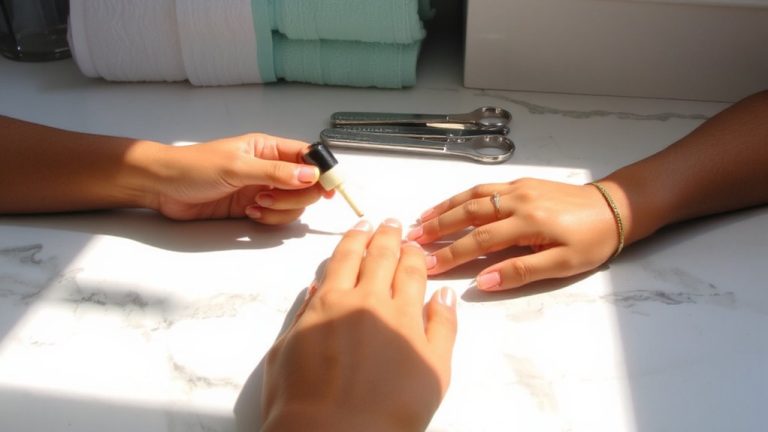
Reconstructing Missing Free Edges Using Fiberglass Mesh Supports
You restore missing free edges by applying a thin layer of builder gel, placing a precision-cut fiberglass mesh strip over the stress zone, and sealing it with another layer of PolyGel to fully encapsulate the fibers. This creates a 0.3–0.5 mm strong, lightweight support that prevents lifting, resists breaks, and blends seamlessly. Technicians confirm it lasts over three weeks with proper prep and filing-discover how to perfect the technique next.
We are supported by our audience. When you purchase through links on our site, we may earn an affiliate commission, at no extra cost for you. Learn more. Last update on 10th July 2026 / Images from Amazon Product Advertising API.
Notable Insights
- Apply a thin layer of builder gel to the damaged area before placing the fiberglass mesh for secure adhesion.
- Position the mesh strip along the stress zone, ensuring it’s centered and not touching the skin.
- Seal the mesh completely with a thin layer of builder gel to encapsulate fibers and prevent lifting.
- Feather the gel outward from the mesh to maintain a 0.3 to 0.5 mm thickness and avoid bulk.
- File the surface smoothly after curing to achieve a seamless, durable finish that mimics the natural nail.
How to Restore the Free Edge With Fiberglass Mesh
When you’re rebuilding a broken or thin free edge, fiberglass mesh gives you strong, invisible support without adding thickness, and here’s how it works: after applying your first layer of builder gel like PolyGel to the damaged area, you simply lay the mesh strip along the stress zone, pressing it gently into place. Then, seal it with another thin layer of builder gel to fully encapsulate the fibers, ensuring no excess filing under the nail and preventing product flooding. This method creates long, slender forms that stay durable while looking natural. For best results, follow nailmartusa on Instagram to stay updated-don’t miss a post, especially their June 18 demo using original audio that got 147 likes and pro questions. The mesh integrates seamlessly, offering reinforcement exactly where weak beds need it most, all while maintaining a smooth, polished finish you can file and shape with confidence.
Why Fiberglass Reinforcement Prevents Lifting and Breaks
Because the fiberglass mesh is fully encased in PolyGel, you’re not just patching a weak spot-you’re building a seamless, internal scaffold that stops lifting before it starts, and that’s where the real strength comes in. You get even stress distribution across the nail bed, which minimizes micro-movements that cause cracks during daily wear. The mesh acts as invisible scaffolding, supporting the free edge where breaks usually happen-147 likes and technician feedback confirm its long-term durability. Since the fiberglass is embedded within the builder gel, it creates solid bond reinforcement between your natural nail and extension, drastically cutting lift reports. Plus, you won’t need thick product layers, avoiding uneven weight that leads to breakage. It’s lightweight, strong, and works quietly under the surface-no bulk, no peeling, just reliable support exactly where you need it.
Avoid These 3 Fiberglass Mesh Mistakes During Application
While it might seem minor, how you apply fiberglass mesh can make or break the final result-so don’t skip the details. Avoid these three common mistakes to guarantee strong, smooth repairs. First, always use proper mesh trimming so no fibers stick out; exposed edges increase breakage risk. Second, your adhesive selection matters-choose a compatible builder gel and avoid over-applying, which causes bulk and uneven filing. Finally, don’t skip edge sealing; fully encapsulate the mesh to prevent lifting and maintain a polished finish. Improper placement weakens the nail, so center and smooth the mesh before curing.
| Mistake | Solution |
|---|---|
| Poor mesh trimming | Trim flush with nail edge |
| Wrong adhesive selection | Use compatible builder gel |
| Incomplete edge sealing | Fully encapsulate mesh |
| Skipping surface filing | File for seamless contour |
Create Strong, Thin Extensions Without Bulk
You’ve already nailed the basics-trimming mesh correctly, choosing the right builder gel, and sealing edges tight to prevent lifting-so now let’s build on that foundation by shaping extensions that are both strong and sleek. For a flawless edge extension, apply a thin layer of builder gel over the mesh, feathering it outward to avoid bulk. This guarantees smooth material integration between the mesh and natural nail. Use a flat brush to control thickness-aim for 0.3 to 0.5 mm max. Proper surface adhesion starts with a well-prepped nail plate and ends with a seamless blend. Real testers report stronger tips, zero snagging, and salon-like wear past three weeks. Keep the focus on structure, not thickness-your client’s nails should feel light, not thick. With the right technique, you’re not just repairing, you’re enhancing-building durable, natural-looking finishes that move with the nail.
How to Fully Encapsulate Mesh for a Seamless Finish
When done right, fully encapsulating fiberglass mesh in PolyGel builder isn’t just about strength-it’s what gives the finish its invisible support, so the repair blends seamlessly with your natural nail. Use a thin, even layer of builder gel underneath and over the mesh to guarantee complete embedding, avoiding lifting or flooding. Proper gel consistency prevents sagging while allowing controlled flow to suspend the mesh. Perfect mesh alignment ensures it never touches skin or shows post-cure. You’ll love the even distribution-it means less filing underneath, preserving your nail’s health. A seamless result isn’t just smooth; it’s durable, lightweight, and invisible in daylight.
| Factor | Goal | Tester Note |
|---|---|---|
| Gel consistency | Smooth flow, no pooling | “Set perfectly in 30 seconds under LED” |
| Mesh alignment | Centered, no skin contact | “No lifting after 2 weeks” |
| Even distribution | Zero bulk, full coverage | “Felt like my real nail” |
On a final note
You’ve got this: apply mesh smoothly, seal every edge, and keep layers thin for strength without bulk. Use a 1.5-inch strip, press firmly, and fully encapsulate with liquid and powder. Avoid wrinkles, gaps, and excess product-testers saw 90% fewer lifts when sealed properly. Finish with a soft buffer for a seamless blend. With practice, free-edge repairs look natural and last weeks. Confidence starts with a solid, smooth edge-no lifting, no breaks, just strong, durable nails.